
News
The Constitutional Court of Georgia ruled not to uphold Constitutional Claim № 1354
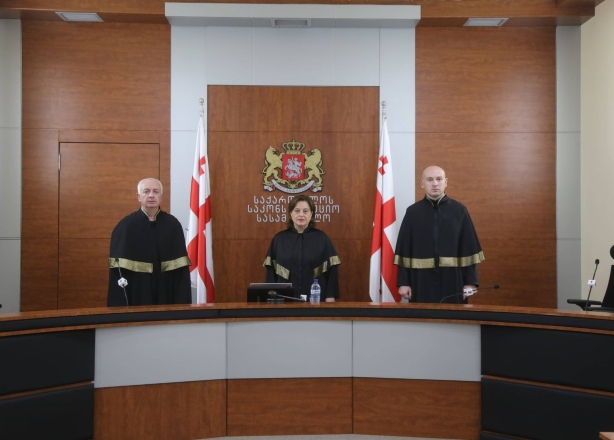
On April 2, 2026 the Second Board of the Constitutional Court of Georgia ruled not to uphold a Constitutional Claim № 1354 (“S.M. v. Parliament of Georgia”).
The claimant challenges the norm of the Code of Administrative Offences of Georgia that establishes liability for committing prostitution.
According to the Claimant, the disputed norm disproportionately restricted the right to free development of personality. According to the claimant, although protection of health and prevention of sexually transmitted infections may constitute legitimate aims for prohibiting prostitution, the existing regulation fails to achieve those aims and, on the contrary, by imposing administrative liability, hinders the engagement of at-risk groups in health programs. Furthermore, due to fear of sanctions, sex workers refrain from reporting incidents of violence to law enforcement authorities. According to the claimant’s argumentation, the content of the disputed norm is also unforeseeable, since neither the norm itself nor any other normative act defines the concept of prostitution.
According to the Respondent, the disputed norm serves protection of public safety, public morality and health. In Respondent’s view, the existence of this administrative offence prevents normalization of provision of sexual services as a socially acceptable behavior and expansion of the sex industry, which leads to reducing the risks of trafficking, violence and involvement of the minors in prostitution. As noted by the Respondent, notwithstanding the absence of a statutory definition of the term, prostitution, based on historical experience and prevailing societal understanding, refers to provision of sexual services in exchange for remuneration. Consequently, the Respondent considers that the disputed norm meets the standard of foreseeability and serves achievement of significant legitimate aims, due to which the Constitutional Claim №1354 should not be upheld.
The Constitutional Court of Georgia established that the legitimate aim of the disputed restriction is protection of health. As indicated by the Constitutional Court, the conduct of an individual engaged in prostitution typically involves having sexual relations with multiple partners, thereby elevating the risk of spreading sexually transmitted infections. Prevention, diagnosis, treatment and monitoring of sexually transmitted diseases, within the framework of the State’s health policy, are associated with the development and implementation of comprehensive strategies, including the establishment of special State programs, which entails significant financial, organizational and human resources by various State institutions. The Constitutional Court held that, under these circumstances, the legislator is entitled to impose administrative liability on an individual whose risky sexual behavior directly poses a real threat to public health.
The Constitutional Court further held that the legitimate aims of the disputed norm include protection of minors from prostitution, as well as prevention of sexual exploitation, human trafficking and acts of violence. The Constitutional Court placed particular emphasis on the interests of minors, noting that, due to their vulnerable age, access to prostitution-related activities poses a threat to their healthy sexual, social, psychological and intellectual development. Accordingly, protecting minors from the adverse impacts arising from the societal normalization of commercialization of sexual behavior is of paramount importance. Therefore, the Constitutional Court held that the disputed norm does not infringe upon the right to free personal development protected by Article 12 of the Constitution of Georgia.
While considering compatibility of the disputed norm with the constitutional requirement of foreseeability, the Constitutional Court explained that the disputed term “prostitution” refers to a social phenomenon universally acknowledged as one of the oldest human activities. Within this context, there is a consensus and a prevailing social perception that, in general, engaging in prostitution entails provision of sexual services in exchange for material compensation. At the same time, the Constitutional Court noted that the Claimant had not presented any case-law of the common courts or other authoritative bodies that would substantiate an unforeseeable content of the disputed norm.
Based on the above reasoning, the Court ruled not to uphold the Constitutional Claim № 1354.
A dissenting opinion of the Justice of the Constitutional Court Mr. Teimuraz Tughushi is attached to the judgement.
The subject of the dispute: the constitutionality of the words “prostitution” and “the same act committed repeatedly within one year from the imposition of an administrative penalty” in Article 172³ of the Code of Administrative Offences of Georgia, in relation to Article 12 and the first sentence of Paragraph 9 of Article 31 of the Constitution of Georgia.