
News
The Constitutional Court of Georgia Rules to Uphold the Constitutional Claim №1317
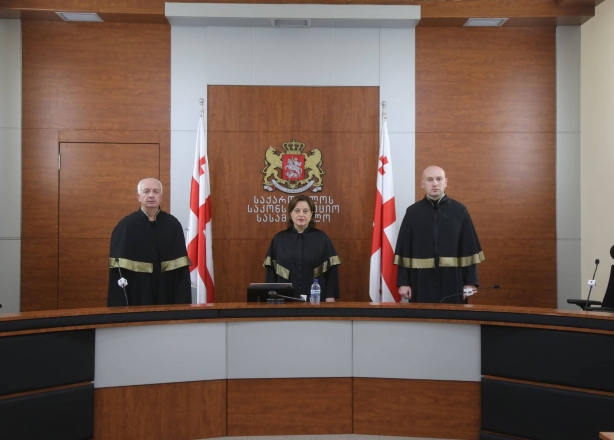
On December 25, 2025, the Second Board of the Constitutional Court of Georgia ruled to uphold the constitutional claim №1317 (“Givi Kapanadze v. the Minister of Internally Displaced Persons from the Occupied Territories, Labour, Health and Social Affairs of Georgia”).
The disputed regulation defined the hospital certificate as the basis for granting the allowance for the period of paid leave for child care, while excluding, except in the exceptional case of the death of the pregnant (giving birth) woman, the possibility of granting the leave and, accordingly, remuneration to the father of the child.
According to the argumentation of the Claimant, disputed norms established discriminatory treatment, on the one hand, between a biological mother and a biological father, and on the other hand, between a biological father and an adoptive father. Additionally, the Claimant considered that the disputed regulation contradicted the right to freedom of labour protected by the Constitution of Georgia.
According to the argumentation of the Respondent, due to the limited financial resources, the selected solution prioritized the protection of women’s rights. Further, the mechanism for dividing the paid leave days among parents by mutual agreement would jeopardize the interests of women's health and the promotion of breastfeeding. For its part, in the case of an employee having adopted a child under one year of age, the purpose of providing leave and relevant remuneration due to the adoption of a newborn was not only to protect the interests of the employee and the child, but also to promote the removal of the child from institutional care and to support the child's integration into a family environment.
The Constitutional Court of Georgia, first and foremost, indicated that in the course of constitutional proceedings on the constitutional claim №1317, the disputed normative act was declared invalid. Furthermore, the amendments proposed into the legislation had a substantial impact on the legal problem identified by the Claimant. Accordingly, the Constitutional Court of Georgia continued the proceedings by assessing the constitutionality of the invalidated disputed norms.
Following the above stated, the Constitutional Court of Georgia assessed the compliance of the disputed regulation with formal requirements of the right to freedom of labour guaranteed by the Constitution of Georgia and explained that the Parliament of Georgia had delegated the competence to develop and approve the procedure for remuneration for the leave due to the adoption of a newborn child to the Ministry of Internally Displaced Persons from the Occupied Territories, Labour, Health and Social Affairs of Georgia. In addition, the legislator itself defined the conceptual issues related to the leave due to pregnancy, childbirth and child care, including the subject of the right, without specifying sex. For its part, on the basis of the disputed norms, the scope of the persons entitled to take a leave due to pregnancy, childbirth and child care and, accordingly, to its remuneration, as defined by the Labour Code of Georgia (as in force before October 5, 2020) was narrowed, which went beyond the scope of the competence delegated to the Ministry by the legislator.
When assessing the compliance of the disputed regulation with the right to equality before the law, the Constitutional Court of Georgia explained that the disputed norms established differential treatment between essentially equal subjects - on the one hand, between the biological father and the biological mother, and on the other hand, between the biological father and the father who had adopted a child under one year of age.
The Constitutional Court of Georgia noted that, despite being regulated as a single legal construct, the leave due to pregnancy and childbirth, on the one hand, and the leave due to child care, on the other hand, existed to ensure autonomous goals. In particular, the leave due to child care ensures the parent’s bond with the child and grants them the opportunity to care for the child and participate in the child’s care process. Furthermore, a biological mother and a biological father share a similar interest and possess similar abilities to be involved in the mentioned process on an equal basis. In view of the above, the Constitutional Court of Georgia concluded that no logical connection was identified between the disputed regulation and the public interest in protecting women’s health.
With respect to the legitimate aim of promoting breastfeeding of children, the Constitutional Court of Georgia indicated that the disputed regulation, in cases when the child’s mother is alive, without any exception, including when the child is not breastfed or when the mother voluntarily refuses to exercise the aforementioned right, excluded the possibility for the child’s biological father to exercise the right to leave due to child care and to receive allowance. Therefore, the disputed regulation restricted the fundamental right to a greater extent than necessary to achieve the above-mentioned legitimate aim.
In addition, while assessing the constitutionality of the differential treatment established between the adoptive father and the biological father, the Constitutional Court of Georgia held that the legitimate aims named by the Respondent had no link with the established differential treatment.
Based on the above reasoning, the Constitutional Court of Georgia, in relation to Article 11, Paragraph 1 and Article 26, Paragraph 1 of the Constitution of Georgia, declared as unconstitutional the normative content of Article 5, Paragraph 1, Subparagraph “a” of the disputed rule, according to which, the basis for granting child care allowance is the hospital certificate issued to an employee and the normative content of Article 9, paragraph 7, which excludes the possibility of granting the leave and, accordingly, child care remuneration to the biological father of a pregnant (giving birth) woman.