News
The Constitutional Court of Georgia dismisses the Constitutional Complaint No. 1735 (“Levan Khandorelashvili v. The Parliament of Georgia”)
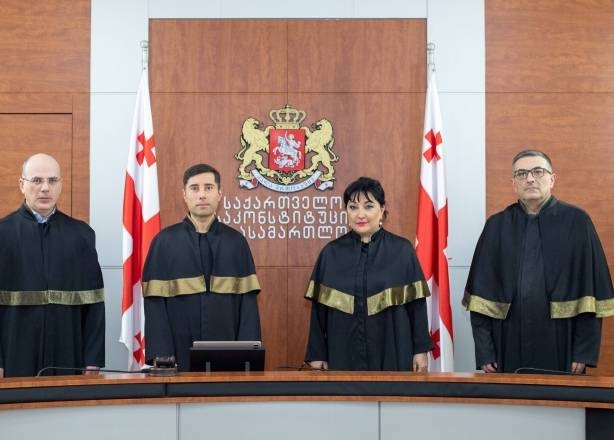
On 7 November 2025, the first board of the Constitutional Court of Georgia dismissed Constitutional Complaint No. 1735 (“Levan Khandorelshvili v. The Parliament of Georgia”).
The subject of the constitutional complaint concerned the normative content of Article 366(1) of the Criminal Code of Georgia, which criminalizes disrespect towards court expressed through insulting a party in legal proceedings, including the cases when the latter did not occur during the hearing in the courtroom, does not obstruct or endanger proper and effective administration of justice or the course of proceedings, and grants the prosecutor a broad discretion. This may result in the criminal liability for the use of expressions beyond profanity, such as “incompetent,” “unqualified,” “ignorant,” or “slave.” According to the claimant’s representative/attorney, imposing criminal liability for profanity directed towards the party during the proceedings is constitutional; however, cases involving less aggressive expressions should be deemed unconstitutional, as individuals may otherwise face prosecution or conviction for such statements. The claimant argued that the State’s interference in the area protected with the right to freedom of expression is excessive, unreasonable, and unjustifi able.
According to the representatives of the Parliament of Georgia, the author of the constitutional complaint was charged and convicted not for using expressions such as “incompetent,” “unqualified,” “ignorant,” “slave,” and similar terms towards the party of the proceedings, but for directing profanity (specifically, an insult involving the prosecutor’s mother) to the prosecutor. Accordingly, the defendant party contends that the claimant’s clarified claim has no connection with the charges brought against him. The representatives of the legislative body further argue that the disputed provision does not contain the normative content alleged by the claimant. Therefore, the constitutional complaint should not be upheld.
According to the caselaw of the Constitutional Court of Georgia, unethical, obscene, uncensored, and insulting expressions are not formally excluded from the sphere protected by freedom of expression. However, the practical level of their protection depends on the specific conflict of values and the legitimate interests involved. The Court has noted that, in some cases, the expression of opinions through radically harsh or aggressive language, including insulting statements, may serve a particular purpose for an individual to convey their views and criticism of the authorities. Nevertheless, this does not negate the fact that obscene expressions carry lesser value, and therefore their protection cannot be equated with well-reasoned, even radically critical statements, as they do not contribute to promoting public debate on significant societal issues. The protective potential of such expressions is further reduced when directed not at political branches of power - the executive and legislative authorities - who have public platforms and numerous means to respond to criticism, but at the judiciary and judges, whose capacity to respond is severely limited. This is another factor that may shift the balance in value conflicts toward protecting the authority of the judiciary. Unlike politicians or other public officials, judges cannot participate in the public debate with the same intensity or adequately respond to criticism due to their status. Accordingly, the Constitutional Court considers that when obscene and uncensored expressions aim to harm the reputation of a judge or a party during legal proceedings, thereby undermining the authority of the judiciary and diminishing public confidence - which is particularly vital in the democratic society - they are afforded a lower likelihood of priority in conflicts of values.
According to the Constitutional Court, the claimant’s representative did not present any case law from the common courts demonstrating that, apart from profanity, other less severe insulting expressions have led to criminal liability under Article 366(1) of the Criminal Code of Georgia. A textual analysis of the provision itself, together with the case law submitted by representatives of the Parliament of Georgia and the Prosecutor’s Office, clearly and unequivocally shows that the normative content identified by the claimant cannot be inferred from the contested regulation. Accordingly, the Court explained that it cannot foresee with which normative content the disputed provision can be applied by the common courts in the future, nor can it hypothetically assess what normative content the provision may or may not acquire. Regarding the claimant’s claim that the prosecutor has unrestricted discretion to broadly and arbitrarily interpret the term “insult,” which would result in an unjustified restriction of the right to freedom of expression, the Court noted that judgments are rendered by the court, not the prosecutor. The prosecutor, as the body responsible for prosecution, also follows approaches established in judicial practice. Moreover, the claimant did not provide any evidence that the Prosecutor’s Office has ever initiated prosecution for less severe expressions. Therefore, the Constitutional Court concluded that Constitutional Complaint No. 1735 should not be upheld.
Subject of the dispute: The constitutionality of the Article 366(1) of the Criminal Code of Georgia in relation with the Articles 17(1) and 17(5) of the Constitution of Georgia.